The Antarctic Star HZB-20EN combines a 44-pound daily production ceiling with a 1.8-liter removable tank, a 2.65-pound basket, and two ice-size settings. That sounds like a lot of machine for a small counter, and in some ways it is. The awkward part is everything between batches: moving ice, refilling water, wiping wet parts, and finding ventilation room around a housing whose dimensions are not presented consistently.
What This Review Covers
- Measure the Antarctic Star Before Trusting “Compact”
- What 10–15 Minutes and 44 lb per Day Actually Mean
- Two Ice Sizes Are Useful, But Exact Dimensions Are Missing
- The 2.65 lb Basket Still Needs Emptying
- A Removable 1.8L Tank Helps Until the Water Runs Out
- The LED Panel Is Simple Enough Without an App
- What 120W Tells You—and What Energy-Save Does Not
- A 20-Minute Cleaning Cycle Does Not Scrub the Basket
- Home Bar or RV? The Better Use Is Obvious
- Who Should Buy the HZB-20EN—and Who Should Skip It
Measure the Antarctic Star Before Trusting “Compact”
The dimensions appear in two different orders. One arrangement calls the machine 12.22 inches deep, 14.96 inches wide, and only 9.45 inches high; the other gives 9.45 inches deep, 12.20 inches wide, and 14.96 inches high. The second arrangement matches a countertop appliance that stands taller than its depth. Treat that as the useful planning measurement: about 9.45 by 12.20 by 14.96 inches.
Even then, do not cut the clearance close. The removable tank and basket need handling room, and the refrigeration system needs somewhere to exhaust warm air. A machine wedged into an exact-width gap may fit physically while becoming miserable to use.
The roughly 115-square-inch base is modest for a kitchen drinks station. It is more noticeable on an RV counter, where the sink, stove, and a safe travel route all compete for the same few feet. Measure the usable space rather than the empty-looking rectangle in a staged photo.
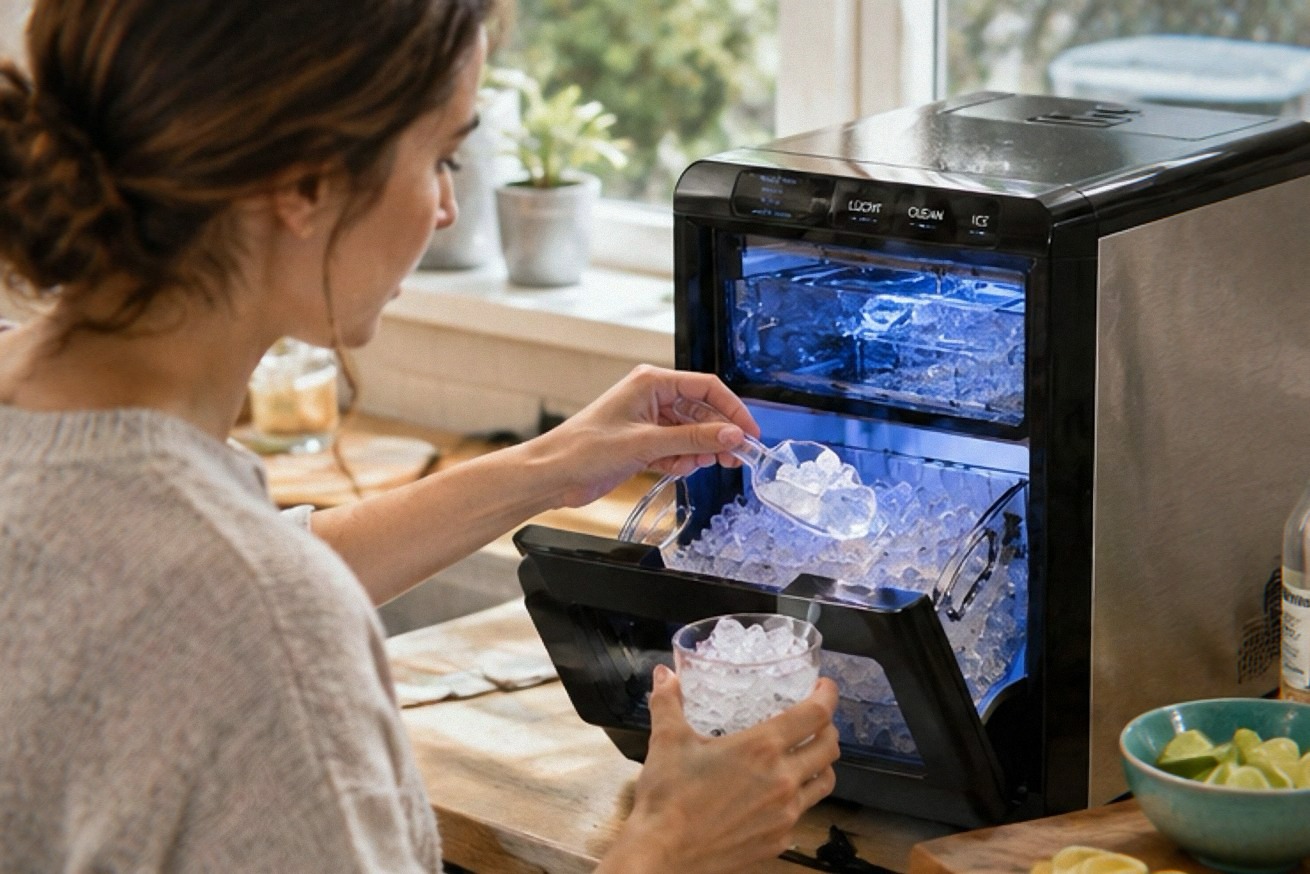
The Removable Parts Need Their Own Space
A removable water tank is convenient only if you can lift it out without striking the cabinet above. The basket also needs a clear path to the sink or freezer. Those movements take more room than the product footprint suggests.
Keep the rear and side ventilation unobstructed with the clearance recommended in the manual. Warm exhaust trapped beneath cabinets gives the compressor a harder job and can lengthen the time needed for later batches.
What 10–15 Minutes and 44 lb per Day Actually Mean
A 10-to-15-minute ice-making cycle gets the first batch moving while you prepare a drink station. It does not put 44 pounds of ice in the basket in fifteen minutes. That distinction sounds obvious, yet daily-capacity marketing encourages people to blur it.
Spread across 24 hours, 44 pounds is about 1.83 pounds per hour under favorable conditions. Actual household production stops and starts. The basket fills, the tank empties, and the machine waits for a person.
There is also an environmental limit. Warm refill water and a hot room force the refrigeration system to remove more heat before ice can form. A unit beside a sunny window or a crowded bar cart will not behave like one operating in a cool, ventilated kitchen.
A Party Needs a Freezer Plan
Start making ice well before guests arrive. Transfer batches to a freezer-safe bag or container, keep that reserve frozen, and use the machine to replenish the serving supply.
The smaller EUHOMY 34 lb nugget ice maker starts producing in roughly six to eight minutes, so it has an advantage when the first handful matters more than the daily ceiling. The Antarctic Star offers the higher 44-pound figure and a larger basket, but neither number removes the need to plan ahead for a crowd.
Two Ice Sizes Are Useful, But Exact Dimensions Are Missing
Two size options give you some control over how the nuggets sit in a glass and how quickly they dilute a drink. Smaller pieces are convenient for chewing and tightly packed iced coffee. Larger pieces make more sense when you want the same general texture with less immediate surface contact.
The exact dimensions of the two settings are not supplied. That is a disappointing omission because size is the entire feature. There is no sound basis for promising that one setting replaces a large cocktail cube or that the other matches a particular restaurant’s pellet ice.
Think of this as two versions of chewable ice, not two unrelated ice types. If you want slow dilution for a spirit, a dense cube from a freezer mold remains the better tool.
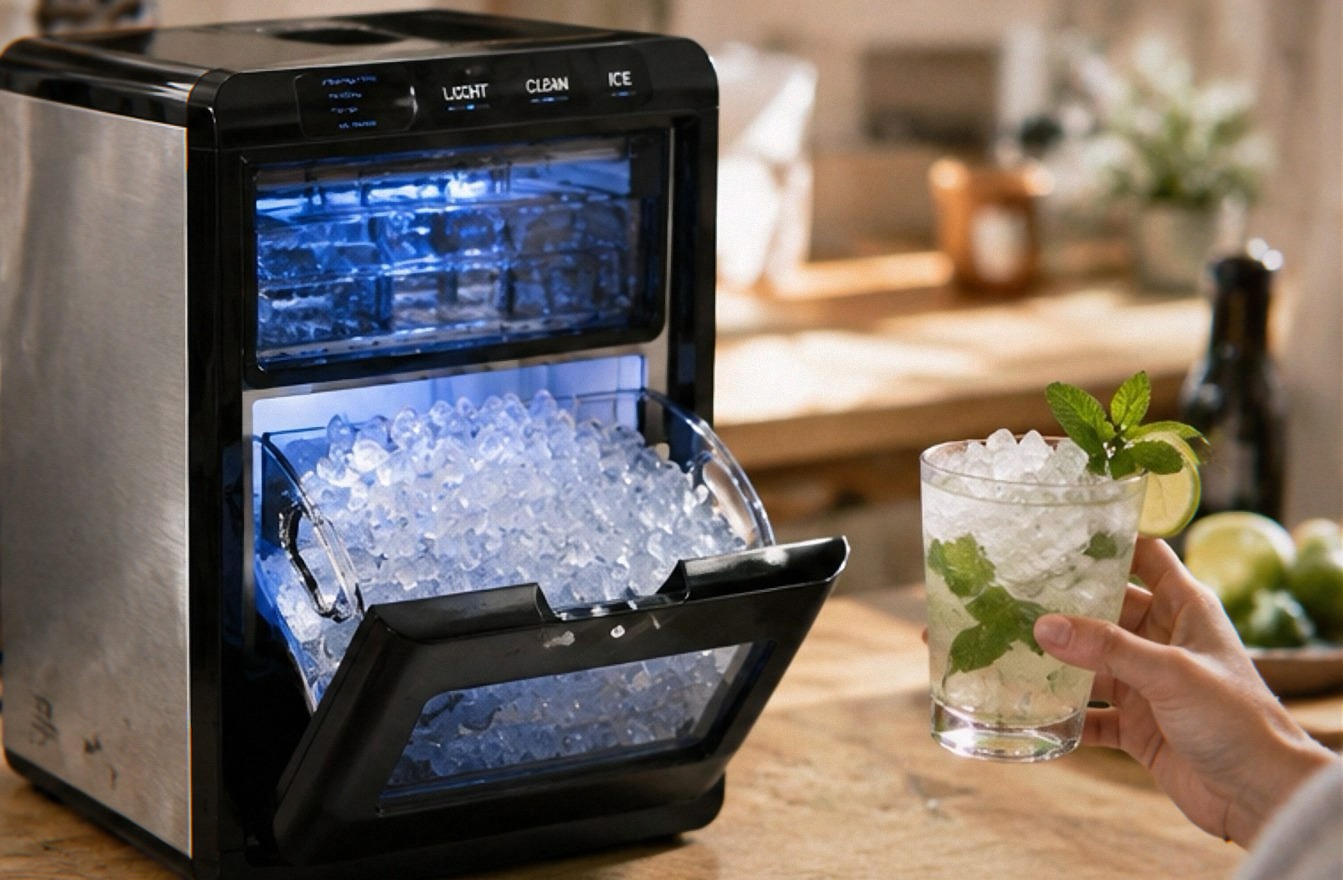
Texture Matters More Than the LED Setting
Nugget ice is less rigid than a solid cube because its structure is not one clear block of ice. It crunches more easily and chills quickly. Small, wet pieces also melt quickly in a warm drink or hot room.
Pre-chilling the glass and the beverage reduces how much melting is needed to bring the temperature down. That simple step improves the drink more reliably than obsessing over a size button.
The 2.65 lb Basket Still Needs Emptying
The basket holds up to 2.65 pounds, approximately 1.2 kilograms. That is enough to make several drinks without running back after every glass, and it is meaningfully larger than a 1.8-pound basket. For a couple or small family, the difference reduces interruptions.
It is still just over six percent of the maximum daily output. A full-basket alert eventually stops the easy part until someone moves the ice. Daily production depends on this boring human task.
The basket is a collection point, not long-term freezer storage. Ice left inside softens and melts as the machine continues its normal cycle. Use fresh ice soon, or transfer it to a freezer if you want a reserve for later.
A Scoop Is Better Than an Automatic Chute for Some Kitchens
The included basket and scoop keep the design mechanically straightforward. You open the machine, lift out ice, and clean the parts that touch it. An automatic dispenser reduces scooping but adds a chute and more internal surfaces to maintain.
That is the comparison at the heart of the Cowsar auto-dispensing nugget ice maker review. Hands-free dispensing is convenient at a busy drinks station; a removable basket is easier to understand and carry to the freezer. The Antarctic Star chooses the second arrangement.
A Removable 1.8L Tank Helps Until the Water Runs Out
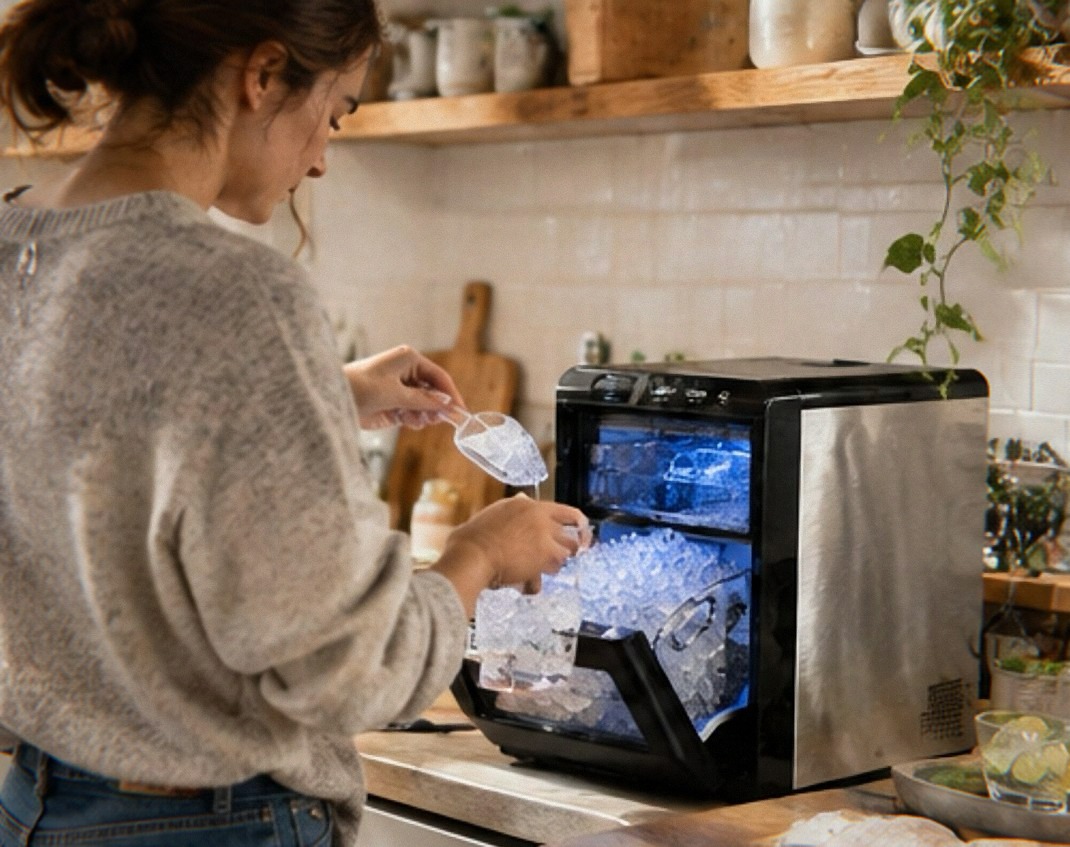
The 1.8-liter tank holds about 60.9 fluid ounces. Filling it at the sink is easier than maneuvering the whole appliance, and the low-water alert tells you when production needs attention. No plumbing connection is necessary.
Forty-four pounds of ice weighs roughly 20 kilograms. Making that much would require approximately 20 liters of water, allowing for normal losses and operating differences. That is around eleven tankfuls across a full day. Nobody should expect to fill 1.8 liters once and wander off until 44 pounds appear.
For ordinary use, the tank size is reasonable. For heavy production, keep a dedicated water jug nearby and treat refilling as part of the routine.
Water Quality Follows the Ice Into the Glass
Whatever tastes unpleasant in your water will not automatically improve when frozen. Use water you would be comfortable drinking, and follow the appliance guidance on filtration and cleaning.
Hard water creates another job. Minerals remain as scale after repeated wetting and drying, eventually coating surfaces and narrowing water passages. The cleaning button cannot prevent chemistry from doing what chemistry does.
The LED Panel Is Simple Enough Without an App
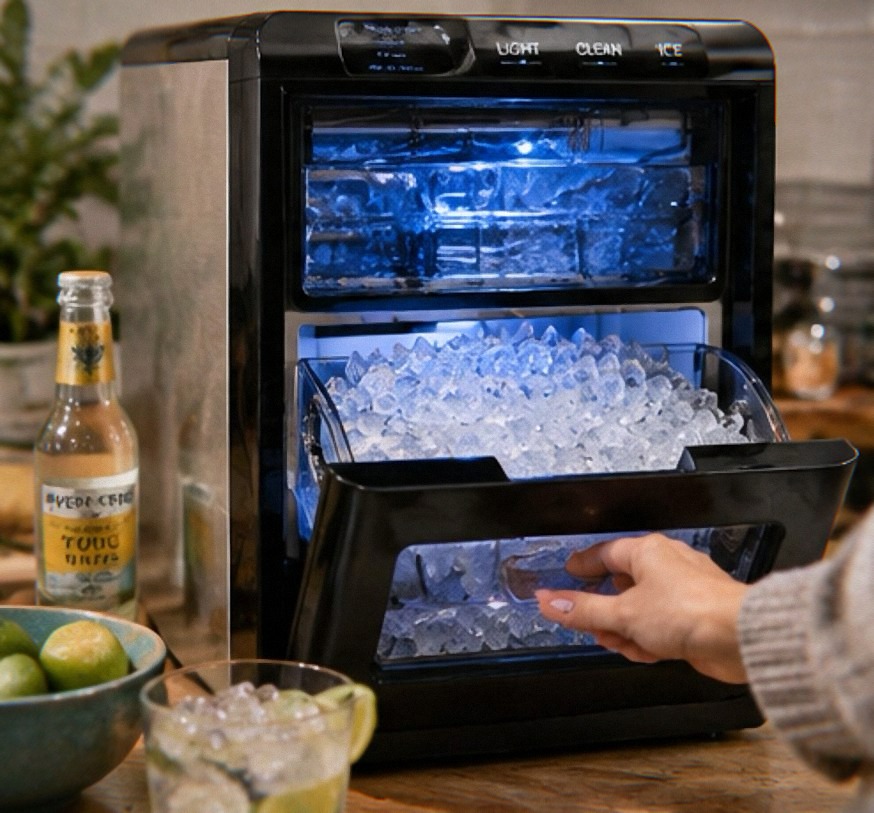
The LED touch panel handles ice production, settings, status alerts, and cleaning mode. Full-basket and low-water alerts address the two interruptions that matter most. There is no need to pair the machine with a phone before asking it to freeze water.
Touch controls are tidy until your fingers are wet. A smooth panel offers less tactile feedback than a raised button, so operate it with dry hands and avoid splashing the display while removing the tank.
Status lights also do not diagnose every problem. A full-basket alert can tell you to empty ice; it cannot tell you whether a stray ice fragment or a dirty sensor is involved. Persistent alerts after emptying and cleaning deserve proper troubleshooting rather than repeated power cycling.
What 120W Tells You—and What Energy-Save Does Not
The rated wattage is 120 watts. If the machine drew exactly that amount for a full hour, it would use 0.12 kilowatt-hours before considering cycling and other operating differences. That gives you a basis for estimating electricity use with your local utility rate.
It does not prove a daily cost because the machine does not necessarily draw maximum power continuously. Compressors cycle, controls use standby power, and production stops when ice or water conditions require attention. Multiplying 120 watts by 24 gives a rough full-draw ceiling of 2.88 kilowatt-hours, not a measured daily consumption figure.
“Energy-save” is too vague to change that math. Without a verified consumption figure per pound of ice or a standardized comparison, the label is not a reason to expect lower running costs than every competing machine.
Heat recovery also goes in the other direction. The appliance removes heat from water and releases it into the room. In a small, hot kitchen, that extra warmth is part of ownership even if the electricity draw looks modest.
A 20-Minute Cleaning Cycle Does Not Scrub the Basket
One-touch cleaning runs for about 20 minutes and gives the internal water path a proper cleaning cycle without making you disassemble the machine. That is worth having. It is not a substitute for washing the removable basket, tank, and scoop.
The idea that no scrubbing is ever needed asks too much of a timer. Kitchen splashes, fingerprints, mineral residue, and handling contamination happen on surfaces that circulating water may never reach.
Follow the manual for the correct cleaning solution and rinse process. Ice absorbs flavors easily, so leftover cleaner is not a minor detail. Let cleaned parts dry before reassembly when practical.
Storage Is Where Neglect Shows Up
After several days away, do not simply top up stale water and start serving drinks. Empty the tank, clean the accessible parts, run the appropriate cycle, and rinse.
Before longer storage, drain and dry the machine. A closed, damp ice maker is an excellent place for odors to develop, and a 20-minute button press weeks later is a poor prevention strategy.
Home Bar or RV? The Better Use Is Obvious
A home bar or office kitchenette makes the most sense. The machine can stay level, connected to suitable power, close to water, and near a freezer for extra storage. The basket and scoop support a serving station without permanent plumbing.
RV use is possible with more planning. You need adequate counter space, a suitable electrical supply, ventilation, and secure storage while driving. Transport can tilt the refrigeration system, so follow the manual’s settling instructions before restarting it.
This is portable in the sense that one appliance can move between locations. It is not a cooler that keeps ice frozen without power, and producing ice on a moving vehicle is a bad idea involving spills, vibration, and unstable operation.
For an office, compressor and ice-drop noise are the other consideration. No verified decibel figure is supplied, so there is no honest basis for calling it library-quiet. Refrigeration hardware and falling ice make sound. Put it in a shared kitchenette rather than beside someone on calls.
Who Should Buy the HZB-20EN—and Who Should Skip It
The Antarctic Star HZB-20EN suits someone who wants chewable ice frequently, prefers a removable basket to a dispensing chute, and will actively manage water and storage. The 2.65-pound basket is practical, the tank comes out for filling, and two size settings add a little flexibility without requiring an app.
It is less convincing for a crowded RV, a silent workspace, or anyone who hates wiping and descaling wet appliances. The missing exact ice dimensions and inconsistent housing dimensions are avoidable annoyances. Buyers should not have to reconstruct the footprint from conflicting measurements.
If you are still deciding between capacities, dispensing styles, and connected controls, use the broader 2026 countertop nugget ice maker guide to narrow the category before focusing on one model. A higher daily output is useful only when the basket, tank, and cleaning routine fit the way you actually drink ice.
The HZB-20EN makes the most sense as a small, manually attended ice station. Its 44-pound ceiling is not magic, and self-cleaning does not end maintenance. Accept those limits and the design is coherent; expect a plumbed, refrigerated, self-scrubbing ice supply and you bought the wrong appliance.
Check the Antarctic Star HZB-20EN Nugget Ice Maker on Amazon
Disclosure: If you buy through the Amazon link above, this site may earn an affiliate commission at no additional cost to you.